Username


  Password


animations
ask Dr. Galv
corrosion
educational seminars
fabricator CD
HDG + Paint
inspectors
literature
published articles
specifier CD
  -corrosion performance
  -cost/economics
  -the HDG coating
  -related specifications
  -ASTM standards
  -sustainable development
  -zinc metal facts
specifier newsletter
techforum

technical info:  specifier CD:  the HDG coating:  paint coating
 

painting hot-dip galvanized steel

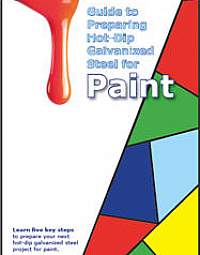
Painting galvanized steel requires careful preparation and a good understanding of both painting and galvanizing. Many products have been galvanized and painted successfully for decades, including automobiles and utility towers. Past experience provides excellent historical data for how best to achieve good adhesion. By studying past adhesion failures and successes, galvanizers, paint companies, researchers, paint contractors, and other sources have created an ASTM specification (ASTM D 6386) detailing the process and procedures for preparing hot dip galvanized steel for painting. When the galvanized surface is prepared correctly, paint adhesion is excellent and the duplex system becomes an even more successful method of corrosion protection.

Galvanized steel can be divided into three categories: newly-galvanized steel, partially weathered galvanized steel, and fully weathered galvanized steel. Each type of galvanized steel must be prepared differently because the galvanized surface has different characteristics at each stage of weathering. It is important to know the age of the galvanized steel that will be painted. Different paint selections are also important to know.

Newly-Galvanized Steel
Newly-galvanized steel is zinc-coated steel that has been hot-dip galvanized after fabrication within the past 48 hours. The newly-galvanized steel should not be water or chromate quenched, nor should it be oiled. This type of galvanized surface is typically very smooth and the surface may need to be slightly roughened - using one of the profiling methods described in this publication - to improve paint adhesion. A newly galvanized surface has little or no zinc oxides or zinc hydroxides, so no major cleaning is necessary.

Partially Weathered Galvanized Steel
Partially weathered galvanized steel is classified as steel that has been galvanized more than 48 hours ago but has been in service for less than two years. At this stage in the life of the galvanized steel, the formation of zinc corrosion products is evident by a light white film present on the galvanized steel. This layer of oxidation must be removed to promote good adhesion between the paint and the galvanized steel. Cleaning of the light corrosion products can be done using many methods mentioned below.

Before painting partially weathered galvanized steel, it is important to know if the coating was chromate quenched. Spot testing the galvanized steel according to ASTM B 201 can determine the presence of chromate conversion coatings. If a chromate coating is detected, the chromate layer must be removed, either by brushing off by abrasive blast cleaning, abrading, sanding or allowing the steel to weather for six months.

Partially weathered galvanized steel also should be slightly roughened to improve paint adhesion. Any of the surface profiling methods described below can be used to prepare the surface.

Fully Weathered Galvanized Steel
Fully weathered galvanized steel has been in service for approximately two years and has completely formed the protective layer of corrosion products known as the zinc patina. The patina has a very stable and finely etched surface, which provides excellent paint adhesion. The only surface preparation needed is a warm water power wash to remove loose particles from the surface. In order to protect the surface, the power wash should not exceed 1450 psi. Allow the surface to completely dry before application of the paint system.

Surface Preparation

There are many different methods used to clean and profile the hot-dip galvanized surface for painting. Below are topics that describe the various methods used to effectively clean hot-dip galvanized steel:

Chemical Cleaning

Alkaline Cleaning
Oil, grease and dirt can be removed by using an alkaline solution in the pH range of 11-12, but not greater than 13. An alkaline solution is nominally 5 to 10 percent sodium hydroxide compounds with small additions of emulsifying or chelating agents. The solution can be applied through dipping, spraying or brushing. If brushing, use a soft bristle brush of nylon, not copper or steel. If dipping or spraying the alkaline solution, the temperature should range between 140 and 185 degrees F. For newly galvanized surfaces, a water-based emulsifier can be used to remove contaminants. After cleaning, thoroughly rinse the surface with hot water and allow to dry completely.

Solvent Cleaning
Mineral spirits, turpentine, high-flash naphtha, and other typical cleaning solvents can be used to clean galvanized surfaces, provided they are applied with lint-free rags or soft bristled nylon brushes that are frequently changed in order to avoid redistribution of the contaminants. After cleaning, thoroughly rinse the surface with hot water and allow surface to dry completely.

Ammonia Cleaning
A solution of one to two percent ammonia applied with a nylon brush can also be used to clean galvanized surfaces, although this method is typically reserved for cleaning parts with ash residue. As a piece of steel is removed from the galvanizing kettle, it may pick up particles of oxidized zinc from the bath surface, otherwise known as ash. Ash residue must be removed prior to painting. After cleaning, thoroughly rinse the surface with hot water and allow drying completely.

Profiling
In order to provide a good adhesion profile for the paint, the galvanized surface must be flat with no protrusions and slightly roughened to provide an anchor profile for the paint system. Filing high spots, sweep blasting, phosphating, and using wash primers or acrylic passivations are the most common methods of increasing the profile of a galvanized surface. Again, care must be taken not to damage the galvanized coating.

High Spots
Any high spots or rough edges should be removed and smoothed out in order to provide a level surface for paint. Use hand or power tools to grind down the high spots. Care should be taken to remove as little zinc as possible.

Sweep Blasting
In order to roughen the typically smooth galvanized surface after cleaning, an abrasive sweep or brush blast may be used. Care should be taken to prevent removing too much of the zinc coating. Particle size for a sweep blast of galvanized steel should range between 200 and 500 microns (8 to 20 mils). Aluminum/magnesium silicate has been used successfully in the sweep blasting of galvanized steel. Organic media such as corn cobs, walnut shells, corundum, limestone, and mineral sands with a Mohs hardness of five or less may also be used. The temperature of the galvanized part when blasting can have a significant affect on the finished surface profile. Sweep blasting while the galvanized part is still warm, 175 to 390 degrees F, provides an excellent profile. Ambient conditions for sweep blasting are recommended to be less than 50 percent relative humidity and a minimum air temperature of 70 degrees F.

Penetrating Sealers
These products are known as a two-part epoxy penetrating sealer that forms a coating approximately two mils thick. They have been used as a surface treatment method on difficult to clean surfaces such as partially weathered galvanized steel. Follow manufacturers directions for application and always use a topcoat over the sealer.

Zinc Phosphate Treatment
As discussed earlier, phosphating is a conversion coating which can increase the adherence and durability of the paint film. The phosphate treatment can be applied by immersion, spray, or soft bristle nylon brush. The phosphate should only be left on the galvanized steel between three and six minutes. The piece should then be washed with clean water and allowed to completely dry. Begin painting when the surface is dry. Do not use phosphate treatments in conjunction with zinc-rich paints.

Wash Primers
This treatment uses a metal conditioner to neutralize surface oxides and hydroxides, as well as to etch the galvanized surface. Wash primers should be applied to the galvanized surface at thickness between 0.3 and 0.5 mils. Thicknesses above 0.5 mils can cause adhesion problems. Because of this, this profiling method is best applied in shop conditions and not in the field. When using wash primers, follow the manufacturers directions for maximum performance.

Acrylic Passivations
This treatment uses an acidic acrylic solution to passivate the galvanized surface, as well as promote paint adhesion. Acrylic passivation products should be applied approximately 0.04 mils thick to a clean galvanized surface. The coating should be completely dry before painting.


Paint Selection

Beyond the need for surface preparation, the paint itself must be compatible with the galvanized coating in order to create a successful duplex system. Many types of paint and paint systems have been used quite well with galvanized steel. However, some types of paint will not adhere adequately to galvanized steel, or will only do so under restricted conditions. In order to ensure a successful duplex system, it is important to find a suitable paint system with a first coat that is fully compatible with a zinc surface. The first coat serves as a "tie coat" or interface between the galvanized steel and the top coat.

To achieve a good interface, it is important to understand the characteristics of all the types of paint that will be used. Each individual formulation of paint exhibits unique characteristics that can affect its suitability for use with galvanized steel. Because of this, only individual paint manufacturers can provide specific guidance on the use of their products. Contact paint manufacturers for specific information regarding the suitability of paint systems for use on galvanized steel.

Below is a table that shows general compatibility between the specified paint system and hot-dip galvanized steel. Click on the individual paint name to get specific information regarding the paint.

COMPATIBILITY OF PAINT WITH GALVANIZED STEEL
Type Compatibility Comments
Acrylics Sometimes If the pH of the paint is high, problems may occur do to ammonia reacting with zinc
Aliphatic Polyurethanes Yes If used as a top coat for a polyamide epoxy primer, it is considered a superior duplex system
Alkyds No The alkaline zinc surface causes the alkyds to saponify, causing premature peeling
Asphalts No Petroleum base is usually not recommende for use on galvanized steel
Bituminous Yes Used for parts that are to be buried in soil
Chlorinated Rubbers Yes High VOC content has severely limited their availability
Coal Tar Epoxies Sometimes Rarely used, only if parts are to be buried in soil
Epoxies Sometimes If paint is specifically manufactured for use with galvanized steel
Epoxy-Polyamide Cured Yes Has superior adherence to galvanized steel
Latex-Acrylics Yes Has the added benefit of being environmentally friendly
Latex Water-Based Sometimes Consult paint manufacturer
Oil-Based Sometimes Consult paint manufacturer
Portland Cement in Oil Yes Has superior adherence to galvanized steel
Silicones No Not for use directly over galvanized steel, can be beneficial in high temperature systems with base coat
Vinyls Yes Usually requires profiling, high VOCs have severely limited their availability
Powder Coating Yes Powder coatings generally work exceptionally well over galvanized steel

Zinc-Rich Paints
Zinc-rich paints have long been recognized for their excellent paint adherence to both new and weathered galvanized surfaces. Zinc-rich paints have been used in the U.S. for more than 75 years and in Europe for well over a century. In a 1960s study by the American Iron and Steel Institute and the Steel Structures Painting Council, zinc-rich paint outperformed all other classes of paint. Significantly, at the nine year inspection in 1970, there was no loss of adhesion to the zinc surface.

With a high percentage of zinc in the dry film, these paints can synergistically combine with the corrosion inhibitive properties of metallic zinc. The zinc dust in paint is integrated with organic binders. These binders allow the zinc particles to remain in contact with each other so the zinc paint can provide cathodic protection.

Zinc-rich paints are an accepted method of repairing damaged galvanized coatings according to ASTM A 780. Zinc-rich paints containing at least 65 percent zinc meet the specification designations. They are widely used for touch-up and repair of damaged galvanized coatings because of their relative ease of application.

Although zinc-rich paints are useful as primers to gain surface adherence, they are also satisfactory as a finish coat when a neutral or matching gray color is desired. These paints can be used alone, but for a more attractive finish a top coat is often employed. While most top coats are easily used, some with very strong solvents may result in a lifting of the primer. Successful top coats include polyvinyl, acrylic latexes, polyurethanes, and polyamide cured epoxies. Specific manufacturer's recommendations should be followed for application and top coating.

Acrylics
Acrylics are single-component coatings, generally applied over a primer due to thin film build. A wash primer may be used with these paints, or they may be applied directly over the hot dip galvanized surface. If the pH of the paint is high, problems may occur due to ammonia reacting with the zinc. Acrylics provide exceptional gloss and color, combined with an extremely durable finish.

Aliphatic Polyurethanes
This is a two-component, high performance system generally applied over a polyamide epoxy primer or a wash primer. These polyurethanes have superior weathering and chemical resistance characteristics with good adhesion, as well as an enamel-like finish. This system requires strict attention to application procedures. If top coating is necessary, a light abrading or roughening of the surface is generally required.

Alkyds
In moist areas, zinc will produce an alkaline surface causing alkyds to saponify, resulting in premature peeling and flaking of the paint system despite initial satisfactory adhesion. Due to this chemical incompatibility with zinc, alkyds are very difficult to use on galvanized surface unless the paint is specifically formulated for using over galvanized steel. Contact the paint manufacturer for more specific recommendations on using an
alkyd paint system.

Asphalts
Asphalts are generally petroleum based products that are not recommended for use on galvanized steel.

Bituminous
These types of paints are thicker than conventional paint systems. As they are coal tar products, unlike asphalts, they can be used with galvanized steel. Bituminous paints are often used over galvanized steel that will be buried in soil.

Chlorinated Rubbers
Although difficult to apply, chlorinated rubbers are fast drying and provide good protection for exterior exposures and chemical resistance to acids, alkalis and most gases. However, they chalk readily and need a high surface profile for good adherence. In addition, their high VOC content has severely limited their availability and end use.

Coal Tar Epoxies
These types of epoxies are rarely used over galvanized steel. They provide outstanding resistance to acidic conditions in splash and spill areas. However, they are difficult to apply and require brush blasting or a wash primer to adhere to galvanized steel. Coal tar epoxies also are often used over galvanized steel that will be buried in the soil.

Epoxies
In most cases, epoxy-esters and epoxy-amines are not generally recommended for use directly on galvanized steel as they are typically high stress materials and may react with the zinc in certain environments, however, epoxies do have some limited success if the paint is specifically formulated for using over galvanized steel. Contact the paint manufacturer for more specific recommendations on using an epoxy paint system.

Epoxy-Polyamide Cured
These epoxies generally have superior adherence to any type of galvanized surface. Because they are not resistant to sunlight, they are typically used as a primer or for corrosive interior applications. A galvanized steel/polyamide epoxy primer/aliphatic urethane top coat system is considered to be a superior high performance duplex system.

Latex-Acrylics
Fast drying and water-based, latex-acrylics have great adhesion, durability and weathering characteristics. This system is often top coated with itself and is suitable for new and weathered galvanized steel. These paints have the added benefit of being environmentally friendly.

Latex Water-Based
This type of latex paint is also fast drying and weathers well, but takes time to cure before it provides acceptable adhesion and abrasion resistance. Therefore, these paints are not recommended for shop application. Adhesion and abrasion resistance improve with time (two to four weeks).

Oil-Based
Oil-based paints are poorly suited for use directly over galvanized steel. These paints are easy to apply, but have unsatisfactory chemical and solvent resistance. They are not generally used over galvanized steel as the oil can react with the alkalinity of the zinc and saponify in moist or humid environments. (see alkyds)

Portland Cement in Oil
These single package paints incorporate Portland cement as part of the pigment. They have outstanding adhesion to galvanized steel, but are often top coated since they do not weather as well as other coatings and may yellow with age. Occasionally, they do become brittle with time, so formulas with special resins designed to preclude embrittlement may have better success.

Silicones
Silicone's suitability for use directly over galvanized steel is poor, and therefore it is not widely used. However, silicone is sometimes employed in high temperature applications where it develops a cross-link silicate that prevents oxidation of the zinc coating. Silicone-alkyd compounds typically do not perform as well as silicon-acrylic compounds.

Vinyls
Vinyls have exceptional resistance to acid and alkali environments and can be supplied as either a thin film needing top coating or as a high-build coating. As a rule, vinyls exhibit only fair adhesion and should be assisted by the use of surface profiling such as a sweep blast or a wash primer. Vinyl acrylics have a great glossy finish with good color retention. High VOC levels have limited their availability and use in certain areas.

Only a partial listing of available paints and paint systems has been provided. The paint manufacturer can provide more thorough information about the compatibility of specific systems with galvanized steel. Always consult the paint manufacturer prior to painting galvanized steel. Different physical and chemical characteristics of the same types of paint may have varied reactions with a galvanized surface. The paint manufacturer and the galvanizer can assist in the creation of a successful duplex system.

 ^ back to top

 
Home | About AGA | About Galvanizing | Galvanized Steel in Use | Technical Info | Members Only | Site Map | Contact | Terms of Use

Developed by Creation Chamber, Inc.